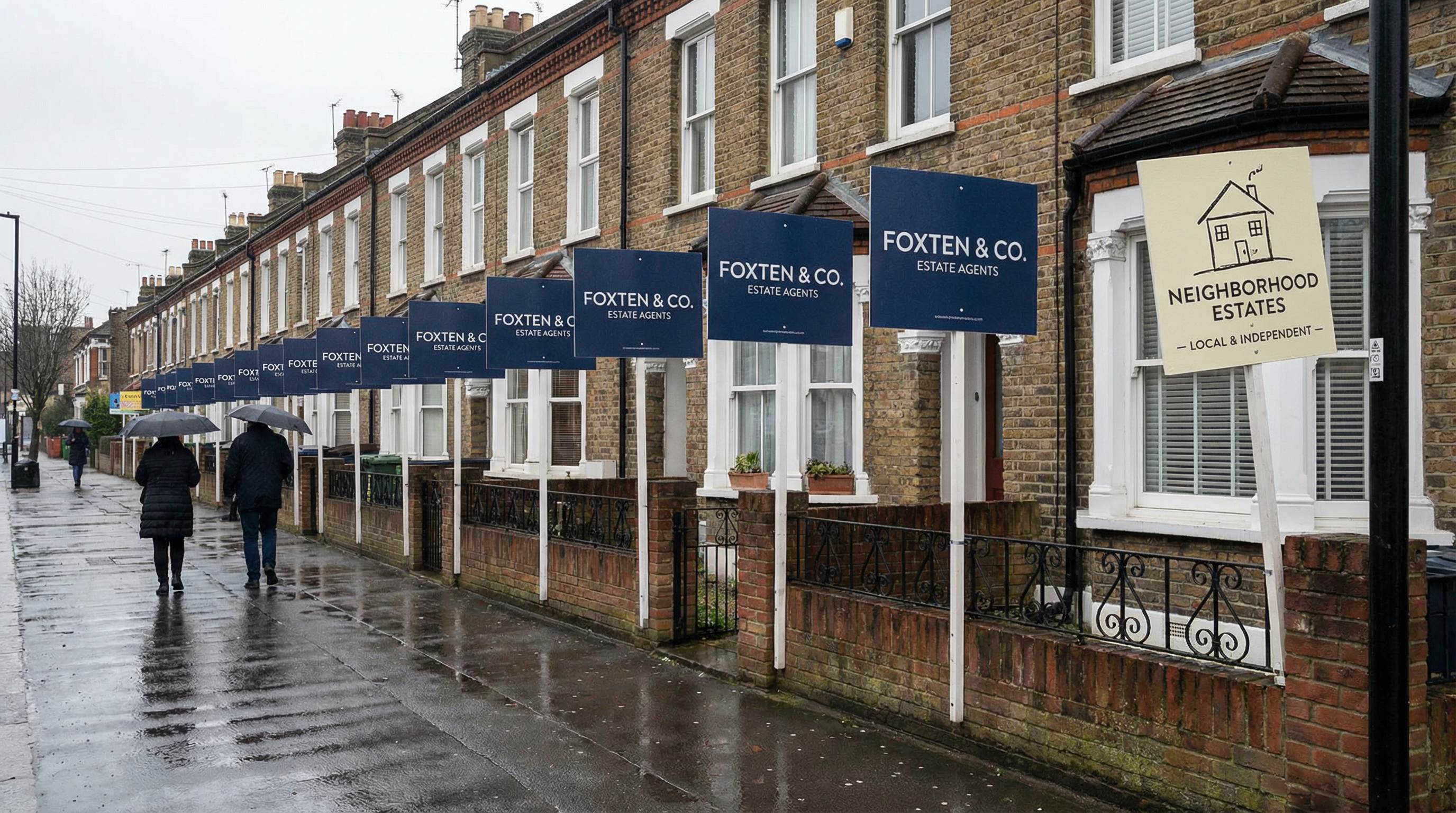

You're selling your most valuable asset. In South London that typically means a property worth £400,000–£800,000. And the marketing most sellers receive from their agent would struggle to pass muster for a secondhand item listed online.
This isn't a slight exaggeration. Scroll through Rightmove right now and make a count of how many listings look as though any genuine effort has gone into them. You'll struggle to find one in ten.
Here's what the standard agent's playbook looks like — and why it costs sellers real money.
Photography
Walk through any portal and the evidence is visible within minutes: photos taken on mobile phones in poor light, at angles that flatten rooms into something unrecognisable, occasionally with the agent's reflection caught in a window. Dark hallways. Wonky horizons. A shot of a radiator that tells a buyer nothing. Sometimes, inexplicably, a close-up of a toilet brush holder.
Professional photography costs an agency approximately £150–250 per property. On a £600,000 sale, that's 0.04% of the transaction value. Yet most agents don't spend it, because when you're listing four to six properties a month across a team, those costs accumulate — and the junior negotiator with a phone produces something that, technically, can be uploaded to Rightmove.
The consequence: your property gets scrolled past. Buyers searching in your area and price range make decisions in seconds based on the lead photograph. A poorly lit, visually flat image doesn't get a click. No click means no viewing. No viewing means no offer.
Professional property photography produces wide-angle shots that show room proportions accurately, lighting that captures both bright and shadow areas, styling that removes distractions, and a coherent visual sequence through the property. The difference in click-through and viewing rates between professional and amateur photography is substantial and well-documented. It is not a luxury — it is the baseline for marketing something worth several hundred thousand pounds.
The Copy Problem
There is a vocabulary that estate agents have developed over decades specifically to convey nothing. "Charming period property." "Sought-after location." "Deceptively spacious." "Wealth of original features." "Beautifully presented throughout."
These phrases appear in thousands of listings simultaneously. They carry no information. A buyer reading them learns nothing about this property that distinguishes it from the fifteen other Victorian terraces currently listed in SE19.
Consider what a listing looks like when this is all it offers: "This stunning family home boasts a wealth of period features and has been beautifully maintained throughout. The spacious accommodation comprises entrance hall, reception room, kitchen/diner, three bedrooms and family bathroom. Attractive rear garden. Viewing highly recommended."
What does a buyer actually know after reading that? Nothing useful. Not whether the kitchen is original or has been updated. Not whether the garden faces south or north. Not what the period features actually are or whether they're attractive. Not anything about why someone would choose to live in this specific street, in this specific area.
Compare this to what the same property could say: "Built in 1905, this three-bedroom terrace sits on one of Crystal Palace's quieter residential roads, a five-minute walk from the Triangle's restaurants and independent shops. The current owners extended into the side return five years ago, creating a 24-foot kitchen-diner that opens onto a south-facing garden — the kind of space that works for weekday mornings and weekend entertaining. Original features include stripped floorboards, high ceilings with detailed cornicing, and working shutters on the sash windows. The loft has been boarded for storage with potential to extend further, subject to planning."
One description could apply to any house. The other applies to this one. Writing the second kind takes longer and requires actually knowing the property. That's precisely why most agents don't do it.
Floor Plans
Floor plans exist to answer a straightforward question: how does this space actually work? Buyers use them to check whether their furniture fits, how rooms connect, whether the layout suits a family, whether a bedroom is a proper double or something else.
A professional floor plan involves accurate measurement and clear CAD drawing. It costs around £80–120. What buyers receive instead, from many agencies, is a sketch produced in free software by whoever was available, sometimes based on the last set of measurements taken when the property was last sold — which may have been before the extension was built.
Inaccurate floor plans don't just fail buyers — they create wasted viewings. A buyer who travels to see a property based on a floor plan that showed a different layout leaves frustrated, and that frustration is associated with the property regardless of whether it would have worked for them with accurate information.
The "Portals and Wait" Strategy
The standard marketing plan at most agencies looks like this: take photos, write description, upload to Rightmove and Zoopla, put a board up, wait.
That's it. No social media. No video content. No proactive outreach to registered buyers whose search criteria match. No email campaigns. No area content that helps buyers understand the lifestyle they're buying into. No drone footage for properties with views. No targeted advertising to buyers who have viewed comparable properties.
Portals do the heavy lifting because agents have allowed them to. Rightmove carries approximately 90% of UK property search traffic. If your property appears there with a compelling lead photo, it gets seen. If the photo doesn't compel, it doesn't. The agent has abdicated responsibility for marketing in favour of the algorithm.
Effective property marketing creates multiple contact points. It reaches buyers who aren't actively searching yet but would respond to the right property presented to them in the right context. It uses the social media presence that most estate agencies nominally maintain but rarely use with any real content strategy. It emails a curated buyer database when a property matches what people have registered interest in. None of this is sophisticated marketing — it's just doing the job properly.
The Viewing Experience
You've spent weeks preparing your home. The agent books a viewing. The agent turns up with minimal knowledge of the property, fumbles through questions about the boiler and the council tax band, and conducts a tour that leaves viewers with no particular impression of why they should want to live there.
A viewing isn't a tour. It's a sales process with a product worth several hundred thousand pounds. A professional agent who knows the property thoroughly — who understands the specific rooms, the light at different times of day, the qualities that make this particular house different from comparable ones — conducts something entirely different from an agent reading from the listing on their phone.
The best viewings create a specific mental image: a buyer who leaves thinking not "I saw a nice house" but "I can see myself living here." That mental image is what produces offers, and it doesn't happen by accident. It happens because the agent understands the property and understands what matters to the specific buyers standing in front of them.
Why This Matters Beyond the Obvious
Poor marketing cascades through the entire sale process. Fewer viewings means less competition. Less competition means buyers have more negotiating leverage and less urgency to offer. Properties with limited interest sit on market longer, accumulate days-on-market stigma, and eventually sell for less than they would have achieved with a properly marketed launch.
The sequence is consistent: underwhelming photography produces fewer clicks, which produces fewer viewings, which produces fewer offers, which produces one buyer negotiating with leverage rather than several competing. The agent then suggests a price reduction. But often the price wasn't the problem — the marketing was. The seller ends up taking less money to compensate for their agent's underperformance.
A property that generates five interested buyers at launch doesn't just sell faster — it frequently sells for more than asking price. A property that generates one interested buyer after six weeks sells for less than asking price, at a moment when the buyer knows they have leverage. The difference in outcome between these two scenarios is often twenty or thirty thousand pounds — not because the market changed, but because the marketing did or didn't work.
What Good Marketing Actually Looks Like
None of what follows is extraordinary. It's simply the standard every property sale deserves.
Professional photography: wide-angle, properly lit, showing every room at its best, with exterior shots in good conditions and detail shots of features worth showing. Video walkthroughs that give buyers a sense of how the space flows. Accurate, professionally-measured floor plans.
Copy that is specific to this property — written by someone who has actually walked through it, knows the road, understands the local area, and can explain why someone would choose to live here rather than three streets away. Not a description that could be pasted into any of fifty other listings without changing a word.
Proactive outreach to a buyer database. Social media content that reaches people in the area. Prompt, knowledgeable responses to buyer enquiries. Feedback after every viewing, communicated to the seller in useful terms rather than vague reassurances.
At Expose, this is how we approach every instruction, whether the property is £350,000 or £1,500,000. It's not a premium service tier — it's what selling someone's most significant financial asset actually requires. The fact that it's uncommon enough to be worth describing says something about the gap between what sellers are usually given and what they deserve.
The Bottom Line
When you choose your agent, ask to see examples of their recent marketing. Look at their active listings. Are the photographs professional? Do the descriptions tell you something specific about the property? Do they produce video? How do they use social media? What does their buyer database look like and how do they use it?
If what you see is phone photography and copy-paste descriptions, you know what your property will receive. The difference between adequate and genuinely good property marketing is measurable — in viewings, in competition, and ultimately in what you achieve at sale.